スーパーのベビーフード棚の前で、20分固まっていました。

鉄入り。アレルゲン対応。オーガニック。5か月から。6か月から。

にじパパのアバター
にじパパ
ひとこと

……で、正解はどれなんだ

帰って調べたら、今度は情報の海で溺れました。なのでWHOと厚生労働省と、日本の大規模研究JECSまで潜って、0歳の食事で本当に守るべきことだけ拾ってきました。

結論から言うと、「絶対」は驚くほど少なかったです。
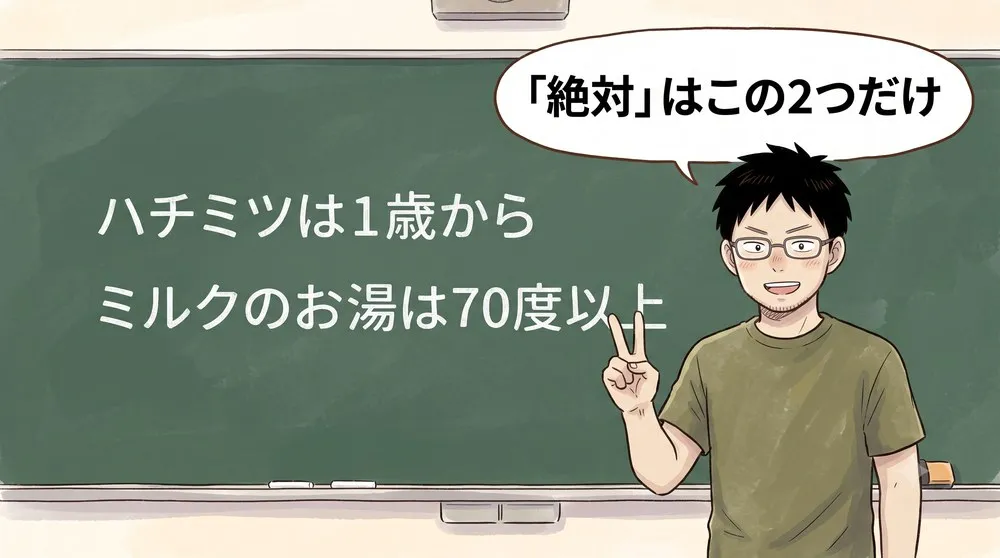
1コマ1コマ漫画。黒板の前に立つ父。黒板には「ハチミツは1歳から」「ミルクのお湯は70度以上」の2行だけ。
0歳の食事で「絶対」なのは、この2つだけ

目次

  1. 「絶対NG」は、何個あるのか?
  2. 母乳とミルク、体重の増え方はどう違うのか?
  3. 6か月からの離乳食、足りなくなりやすい栄養は何か?
  4. 離乳食が続かないのは、親の怠慢なのか?

「絶対NG」は、何個あるのか?

公的資料レベルで交渉の余地がないのは、主にこの2つでした。

  • 1歳未満にハチミツを与えない(乳児ボツリヌス症のリスク。加熱してもダメ)
  • 粉ミルクは70℃以上のお湯で調乳し、作って2時間以内に使わなかった分は捨てる

どちらも厚生労働省がはっきり書いています。逆に言うと、ここさえ守れば、残りの大半は「推奨」の世界です。

少し気が楽になりませんか。僕はなりました。


母乳とミルク、体重の増え方はどう違うのか?

WHOの原則はシンプルです。生後6か月ごろまでは母乳が最適、6か月ごろから離乳食を始めつつ母乳は継続。これが世界共通の土台になっています。

ただ、現実は母乳・ミルク・混合、家庭それぞれですよね。

ここで面白いのが日本のJECS(10万組規模の親子コホート)から出た研究です。母乳中心の子は早い時期にぐっと伸びて8〜12か月以降はゆるやかに、混合・ミルクの子は最初ゆるやかで、あとから追いつく傾向がありました。

つまり、授乳方法によって成長カーブの「形」がそもそも違う。よその子と体重の1点を比べて一喜一憂しても、あまり意味がないわけです。

:点じゃなくて、線で見ろってこと?

そういうことらしいです。うちの子の「線」は、健診で見てもらいましょう。

ちなみに、うちの離乳食風景がこちらです。
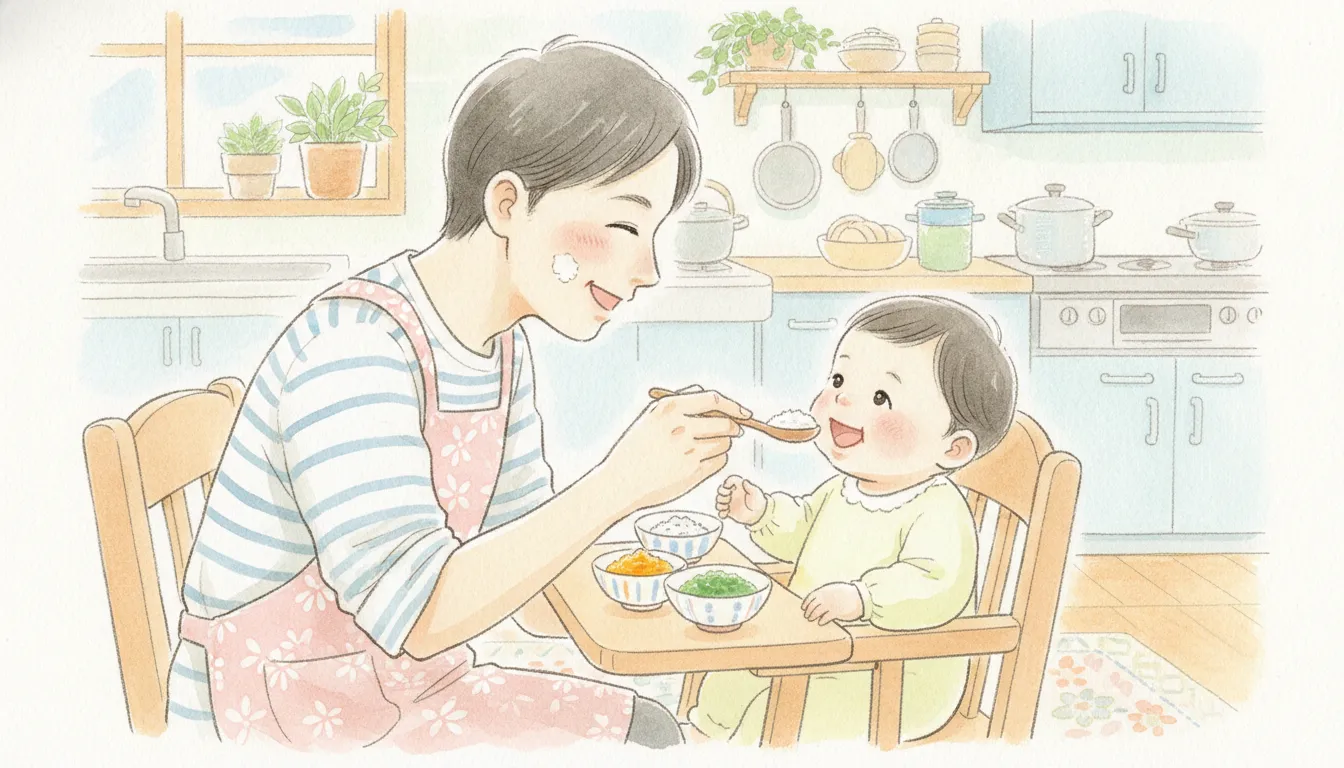
キッチンでハイチェアの赤ちゃんに離乳食をスプーンであげる、エプロン姿の親(水彩イラスト)
エプロンは妻のを借りています。花柄です。

6か月からの離乳食、足りなくなりやすい栄養は何か?

アジアの6〜23か月児の食事を分析した研究では、優先度の高い栄養素として鉄、亜鉛、ビタミンA、葉酸、ビタミンB12、カルシウムが挙げられていました。

特に鉄。6か月を過ぎると、母乳だけではだんだん足りなくなってきます。

「いつ始めるか」ばかり気にしていましたが、研究の世界では**「何をどれだけ詰め込むか(栄養密度)」**のほうが主戦場でした。おかゆだけで満腹にさせない、が合言葉です。


離乳食が続かないのは、親の怠慢なのか?

2025年に出たアジアの親たちの研究レビューによると、離乳食の実践を左右するのは知識だけではありませんでした。

祖父母の意見。食材の値段。仕事復帰。医療者からの説明のわかりやすさ。そういう環境要因が実践を左右すると、何度も報告されています。

つまり「続かない=あなたのせい」ではない。ベビーフード併用は白旗ではなく、戦略です。

まとめ

ハチミツと70℃だけ死守して、あとは「うちの子の線」を健診で見てもらう。

なお、記念すべき10倍がゆ初日、スプーンは天井方向へ旅立ちました。

にじパパ「エビデンス育児」関連記事

※この記事は論文・公的資料の紹介で、診断や治療の代わりにはなりません。個別の心配ごとは健診やかかりつけの小児科で相談してください。
主な出典:WHO 補完食ガイドライン2023/厚生労働省の食品安全情報(ハチミツ・調乳)/こども家庭庁 母子健康手帳情報支援サイト/JECS(子どもの健康と環境に関する全国調査)由来の授乳と成長の研究/アジアの補完食実践に関する系統的レビュー2025・南/東南アジア微量栄養素研究。詳しくは WHO厚生労働省こども家庭庁 へ。

No Honey, and Water at 70°C: Feeding a Baby Under One Has Surprisingly Few 'Absolutes'

I spent twenty minutes frozen in front of the baby-food shelf at the supermarket.

Iron-fortified. Allergen-friendly. Organic. From 5 months. From 6 months.

にじパパのアバター
にじパパ
ひとこと

…So which one is the right answer?

Back home, I tried to look it up and promptly started drowning in a sea of information instead. So I dove down through the WHO, Japan's Ministry of Health, Labour and Welfare (MHLW), and even JECS, Japan's massive parent-and-child study, and came back up holding only the things you genuinely have to get right when feeding a baby in the first year.

The conclusion up front: the list of "absolutes" was astonishingly short.

Table of Contents

  1. How many "absolute no's" are there, really?
  2. Breast milk vs. formula: how does weight gain differ?
  3. Solids from six months: which nutrients run short first?
  4. If solids aren't going well, is that parental laziness?

How many "absolute no's" are there, really?

At the level of official public-health guidance, the things with zero room for negotiation mainly came down to these two.

  • Do not give honey to a baby under one year old (risk of infant botulism — and no, heating it doesn't make it safe).
  • Prepare powdered formula with water at 70°C (158°F) or hotter, and throw away any prepared formula that hasn't been used within two hours.

Both are stated in black and white by Japan's Ministry of Health, Labour and Welfare (MHLW). Flip that around: keep these two rules, and most of everything else lives in the world of "recommendations."

Doesn't that take a little weight off your shoulders? It did mine.


Breast milk vs. formula: how does weight gain differ?

The WHO's principle is simple. Breast milk is optimal until around six months; start complementary foods at around six months while continuing to breastfeed. That is the baseline shared worldwide.

But in real life it's breast milk, formula, or some mix of the two — different for every family.

Here's where it gets interesting: a study out of Japan's JECS (the Japan Environment and Children's Study, a parent-child cohort of roughly 100,000 pairs). Babies fed mainly breast milk tended to surge early and then grow more gently from around 8–12 months onward, while mixed-fed and formula-fed babies started out slower and tended to catch up later.

In other words, the very "shape" of the growth curve differs by feeding method. Comparing your baby's weight at one single point against another child's, and feeling elated or crushed by it, doesn't mean much.

Wife: So… read the line, not the dot?

Apparently, yes. As for our own kid's "line," we'll have it read at the regular checkups.

Incidentally, here is what mealtime looks like at our house.

Watercolor illustration of a parent in an apron spoon-feeding baby food to a baby in a high chair in the kitchen
The apron is borrowed from my wife. It's floral.

Solids from six months: which nutrients run short first?

A study analyzing the diets of children aged 6–23 months in Asia listed iron, zinc, vitamin A, folate, vitamin B12, and calcium as the high-priority nutrients.

Iron above all. Past six months, breast milk alone gradually stops being enough.

I had been fixated on "when do we start?" — but in the research world, the main battleground is what you pack in, and how much (nutrient density). The watchword: don't let plain rice porridge be the thing that fills them up.


If solids aren't going well, is that parental laziness?

According to a review of studies on parents across Asia published in 2025, what shapes complementary-feeding practice is not knowledge alone.

Grandparents' opinions. The price of ingredients. Going back to work. How clearly health professionals explain things. Again and again, studies report that environmental factors like these drive what parents actually do.

Which means "we couldn't keep it up" does not equal "it's your fault." Using store-bought baby food isn't a white flag — it's strategy.

The Takeaway

Guard the honey rule and the 70°C rule with your life; for everything else, have your own child's "line" looked at during checkups.

Also, for the record: on the momentous first day of 10-to-1 okayu — rice porridge at its most watery, Japan's classic first food — the spoon set off on a journey toward the ceiling.

More from Nijipapa's "Evidence-Based Parenting" series

Note: This post is an introduction to published research and official guidance, and is not a substitute for diagnosis or treatment. For concerns specific to your child, please consult your pediatrician or bring them up at a well-baby checkup.
Main sources: WHO guideline on complementary feeding (2023); food-safety information from Japan's Ministry of Health, Labour and Welfare (MHLW) on honey and formula preparation; the Children and Families Agency's Maternal and Child Health Handbook information site; research on feeding methods and growth from JECS (the Japan Environment and Children's Study); a 2025 systematic review of complementary-feeding practices in Asia and micronutrient research from South/Southeast Asia. For more, see the WHO, MHLW, and the Children and Families Agency.